
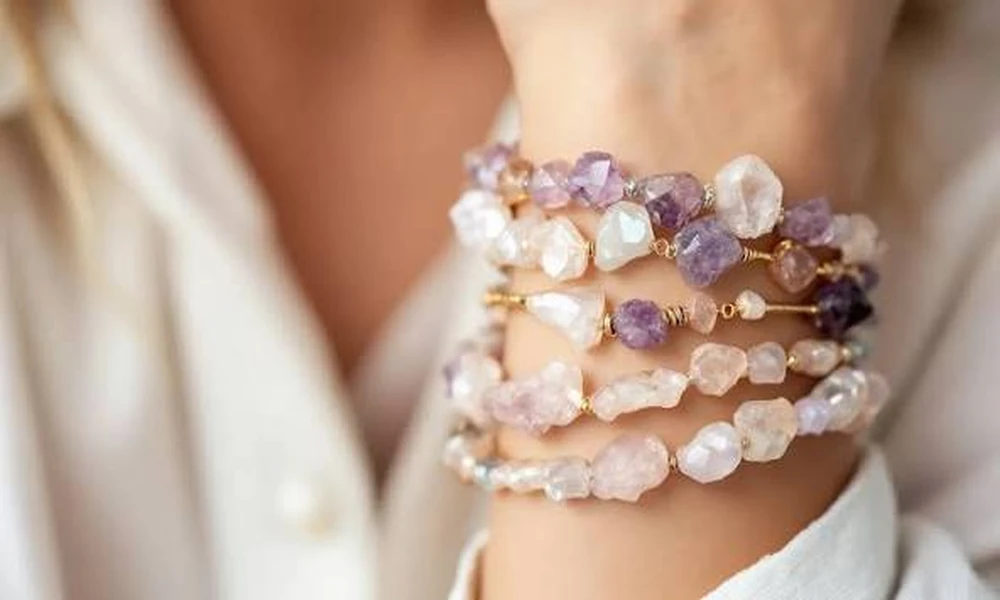
Walk into any crystal shop in India and you will hear two confident answers: “left hand, always” and “right hand for results.” Both come with reasons, and both are partly tradition, partly modern belief. So which hand to wear a crystal bracelet on, really?
This guide sets out the common rules, where they come from, how Indian traditions like palmistry and Vedic astrology add their own layers, and how to decide for yourself. Nothing here is a medical or scientific claim. These are traditional associations and what many wearers report.
The Basic Rule: Left Receives, Right Gives
The most widely repeated crystal-healing guideline is simple:
- Left wrist: the “receiving” side. Worn here, a stone is believed to draw in its qualities, such as calm, protection or clarity.
- Right wrist: the “giving” side. Worn here, a stone is believed to project energy outward, supporting action, confidence and expression.
The idea is that the left side of the body is linked with intuition and receptivity, and the right with action and output. This is a modern crystal-healing framework rather than an ancient scripture, but it is the one most sellers and wearers follow today.
A practical note: many people say “non-dominant hand for receiving” instead. If you are left-handed, some practitioners simply reverse the rule. There is no authority that settles this, so treat it as a guide.
What Indian Traditions Add
India has its own lenses, and they sometimes differ from Western crystal advice.
Palmistry and the Right Hand
In traditional Indian palmistry (Samudrika Shastra), the right hand is often read for men and the left for women, as the hand said to show what is “carried” into life. Some families extend this to jewellery, so men wear stones on the right and women on the left. It is a family or regional custom, not a universal rule.
Vedic Astrology and Gemstone Rings
Astrological gemstones are traditionally worn as rings, on a specific finger, usually of the right hand, and often on a particular weekday after a ritual. Examples include Gomed (hessonite) linked with Rahu and Neelam (blue sapphire) with Saturn. Because these are strong, chart-specific recommendations, they are best discussed with a trusted astrologer.
Crystal bracelets are generally treated as gentler, more general-purpose wear. A bracelet in amethyst or rose quartz is usually chosen for mood and intention, not as a prescribed planetary remedy.
Choosing the Hand by Purpose
If you want a practical way to decide, match the hand to what you hope the stone supports.
| Purpose | Suggested wrist | Example stones |
| Calm, anxiety, sleep | Left | Amethyst, blue lace agate, moonstone |
| Love, self-compassion | Left | Rose quartz, rhodonite |
| Evil eye (nazar) protection | Left | Black tourmaline, obsidian |
| Money, career, drive | Right | Citrine, pyrite, green aventurine |
| Confidence, focus | Right | Tiger eye, carnelian |
| Meditation, intuition | Left | Labradorite, lapis lazuli, clear quartz |
Many wearers pair one stone for each wrist, for example citrine on the right for ambition and amethyst on the left for steadiness. If that feels right to you, it is a perfectly reasonable approach.
Which Hand for Protection Stones?
Protective stones such as black tourmaline are usually worn on the left, as the receiving side that “absorbs” negativity. Some Indian households prefer the right for nazar protection, particularly for children’s black thread or bead bracelets. Both customs are common. Choose the one your family follows or the one that feels comfortable.
Does Gender Matter?
Traditional palmistry-based customs say yes, but modern crystal practice mostly says no. Today, most guides recommend choosing by purpose and comfort. If your family follows the gender-based rule, there is no harm in honouring it.
Practical Tips That Matter More Than the Rule
Hand choice is only one part of wearing a bracelet well.
1. Set an intention. Hold the bracelet for a minute and decide what you want it to remind you of before putting it on.
2. Get the fit right. A bracelet should sit snugly but slide slightly. Elastic cord pieces suit most wrists.
3. Remove it for heavy work. Take it off while bathing, swimming, exercising or applying perfume, as water, sweat and chemicals can dull stones and weaken the cord.
4. Cleanse it regularly. Smoke from incense or sage, moonlight, or a few minutes on a bowl of rock salt (avoid for porous or delicate stones) are common methods. Many people also cleanse and recharge on Shivratri or full-moon nights.
5. Limit layering. Combining too many stones with different purposes can feel muddled. Two or three that work together are plenty.
Spotting Genuine Stones
Whichever hand you choose, the stone should be real. Common lookalikes include dyed howlite sold as turquoise, glass sold as “opalite” or “sunstone,” and heat-treated amethyst passed off as citrine. Natural stones usually vary slightly in colour and pattern, feel cool to touch and are often heavier than glass. Be wary of perfectly uniform, very bright colours at very low prices. Ask the seller about origin and treatment, and buy from someone who answers openly.
Frequently Asked Questions
Can I wear a crystal bracelet on either hand?
Yes. There is no harm in wearing it on either wrist. The left-right rule is a guideline, not a requirement.
Which hand should I wear a rose quartz bracelet on?
Most people wear it on the left, linked with the heart and receiving love. It is also traditionally associated with self-acceptance.
Which hand for a citrine or pyrite bracelet?
The right is commonly suggested, as these stones are associated with action, confidence and abundance. They are not guarantees of wealth, so continue to rely on sound financial planning.
Should I wear the bracelet all the time?
Many people do, but removing it for sleep, bathing or workouts is kinder to the stone. Wear it in the way that fits your routine.
What if I am left-handed?
Some practitioners reverse the rule. Follow whatever feels natural to you.
Conclusion
The short answer to which hand to wear a crystal bracelet on: the left to receive calm, protection and intuition, and the right to give energy toward goals, confidence and action. Indian customs around palmistry and astrology add variations, but none of them is binding. What matters more is a genuine stone, a clear intention and regular cleansing.
If you are unsure which stone suits you, Ankastra’s bracelet collections by need or numerology number are a gentle place to begin, and the free crystal guidance can help you choose a stone and decide which wrist feels right.

Comments are closed.